2026 Jeep Grand Cherokee L: How the Three-Row Grand Cherokee Actually Works
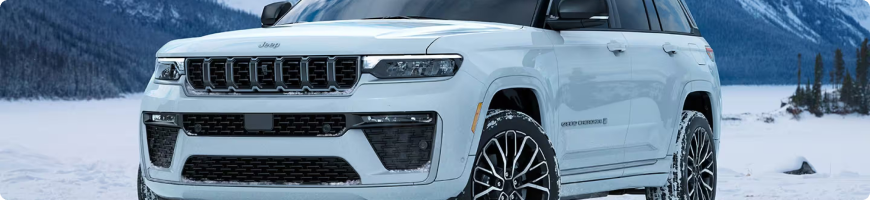
The Grand Cherokee L is the long-wheelbase Grand Cherokee with a third row in it. It seats up to 7, tows up to 6,200 lbs
when properly equipped, and the base Laredo in 4x4 launched at $42,920. Those numbers point at one household: the family
that has outgrown five seats and has no interest in a minivan. If that is where you are, start with the
Grand Cherokee L models on our lot.
The figure above is the MSRP at launch for the 2026 model year, excluding destination, which was a separate $1,995
charge when the model arrived. What a vehicle costs turns on how it is built and on the incentives running at the time.
The L or the Two-Row Grand Cherokee
This is where most Grand Cherokee shoppers get stuck, and it comes down to 11.4 inches of body and one extra row.
Measurement
Grand Cherokee, 2 rows
Grand Cherokee L, 3 rows
Seating
Up to 5
Up to 7
Overall length
193.5 in
204.9 in
Wheelbase
116.7 in
121.7 in
Passenger volume
144.6 cu ft
159.1 cu ft
Cargo behind the second row
37.7 cu ft
46.9 cu ft
Cargo behind the front row
70.8 cu ft
84.6 cu ft
Cargo behind the third row
No third row
17.2 cu ft
Eleven inches is about the long side of a sheet of printer paper. In a driveway you will never notice it. In an older
attached garage it decides whether the door clears your tailgate. The 5 extra inches of wheelbase do the real work,
because the wheelbase is the part that holds seats rather than the bumper.
Take the L if: you carry six or seven people even occasionally, or five plus a week of luggage often
enough that 37.7 cubic feet keeps coming up short.
Take the two-row if: a third row would only ride empty. It parks more easily and costs less to start.
Beyond size and seating the two are closely matched, sharing both engines, the 6,200-lb maximum and the warranty, so
this really is a decision about people and cargo. Our
two-row Grand Cherokee inventory
shows how the shorter one is built. If the L still looks small for what you carry, the larger
Grand Wagoneer
sits above it in the Jeep lineup.
The Third Row, Honestly
Measurement
First row
Second row
Third row
Head room
39.8 in
39.9 in
37.3 in
Leg room
41.3 in
39.4 in
30.3 in
Shoulder room
59.2 in
58 in
51.9 in
Hip room
57.4 in
56.3 in
42.9 in
Thirty inches for the legs makes the back row a real seat for kids and smaller teenagers, workable for an adult across
town, and not somewhere two grown adults will thank you for on a drive to Chicago.
Head room is the surprise. At 37.3 inches the back row gives up only about two and a half inches to the front seats, so
a tall passenger runs out of knee room long before head room. Width goes the other way: 51.9 inches across the shoulders
is a two-adult bench, not a three-adult one.
The middle row is the strong seat here. At 39.4 inches of leg room it is within 2 inches of the driver’s seat, so an
adult riding there has effectively a front-seat amount of space. It is also the easiest row to reach a buckle from with
the door open, which is why car seats usually belong there, with older kids behind them.
One thing to check on the vehicle in front of you: seven is a ceiling, not the only count, because the L is built in
both 6-passenger and 7-passenger configurations.
Cargo, Row by Row
A cargo figure means nothing until you say which row it sits behind, so each of these names its row.
Seats in use
Cargo space
What that actually holds
All three rows, 7 seats
17.2 cu ft behind the third row
A full grocery run, or a folded stroller with the diaper bag beside it
Third row folded, 5 seats
46.9 cu ft behind the second row
Hard-sided luggage for five for a week, or two large dog crates
Both rear rows folded, 2 seats
84.6 cu ft behind the front row
A mini fridge, storage totes and a desk chair in one trip
With all three rows up, 17.2 cubic feet is a deep well rather than a long floor, which matters more than the number
suggests: a stroller stands in it, a wide suitcase does not lie flat. Fold the third row and the hold nearly triples,
which for many households is the everyday setting. You are buying the option of seven seats, not the obligation to
surrender your cargo floor.
Payload: this is the weight the vehicle is built to carry, and everything counts toward it, including
passengers, gear and the downward push of a trailer. Across the L’s 6- and 7-passenger builds it runs 1,210 to 1,400
lbs, and a 4x4 Laredo is rated at 1,370 lbs.
The Two Engines
Two gas engines, both on an 8-speed automatic, both on regular fuel from a 23-gallon tank. Each comes with rear-wheel
drive or with the build that drives all four wheels, which Jeep sells as 4x4. One naming quirk shows up in the table:
the EPA files that four-driven-wheel build as 4-wheel drive with the turbo and all-wheel drive with the V6.
Engine
Horsepower
Torque
Drivetrain
EPA-estimated city / hwy / combined
2.0L Hurricane 4 Turbo
324 hp @ 6,000 rpm
332 lb-ft @ 3,000 to 4,500 rpm
Rear-wheel drive
21 / 26 / 23 MPG
2.0L Hurricane 4 Turbo
324 hp @ 6,000 rpm
332 lb-ft @ 3,000 to 4,500 rpm
4-wheel drive
20 / 25 / 22 MPG
3.6L V6
293 hp @ 6,400 rpm
257 lb-ft @ 4,000 rpm
Rear-wheel drive
19 / 26 / 21 MPG
3.6L V6
293 hp @ 6,400 rpm
257 lb-ft @ 4,000 rpm
All-wheel drive
18 / 25 / 21 MPG
The turbo is the stronger engine and the more efficient one at once, which is unusual: 31 more horsepower, 75 more
lb-ft, and a better rating in every drive configuration. Torque is the figure a family driver actually feels, and the
turbo’s 332 lb-ft arrives from 3,000 rpm, a full 1,000 rpm before the V6 peaks. That is the range you live in pulling a
loaded vehicle away from a light on Scatterfield Road.
So why take the V6? Because a naturally aspirated six cylinder delivers its power in a way plenty of drivers prefer, 293
hp is not short of what a three-row family SUV needs, and both engines reach the same 6,200-lb towing ceiling. Choosing
it costs nothing in what the vehicle can pull, so drive both; this one is a feel question rather than a numbers
question.
What It Tows
A properly equipped Grand Cherokee L tows up to 6,200 lbs. For a three-row family SUV that is a useful number, and it
covers most of what a Central Indiana household hitches up on a Friday afternoon:
A small travel trailer, a teardrop camper or a pop-up
A pair of personal watercraft on a tandem trailer
A 17-foot to 19-foot aluminum fishing boat with its trailer and gear
A landscape trailer with a zero-turn mower and mulch on it
The heavy stuff sits outside that figure. A 30-foot bunkhouse trailer or a loaded car hauler belongs behind a full-size
truck, and the line between them is loaded weight, not length.
Two habits keep you honest against the rating. Weigh the trailer loaded rather than dry, because a camper’s dry weight
carries no water, propane, bikes or cooler, and a weekend’s worth of all four adds hundreds of pounds. And remember that
a trailer pushes down as well as back, out of the same payload allowance carrying your family. Because 6,200 lbs is a
maximum and a vehicle’s own rating follows how it was built, ask us to confirm it before you buy a trailer.
Screens, Audio, and Safety
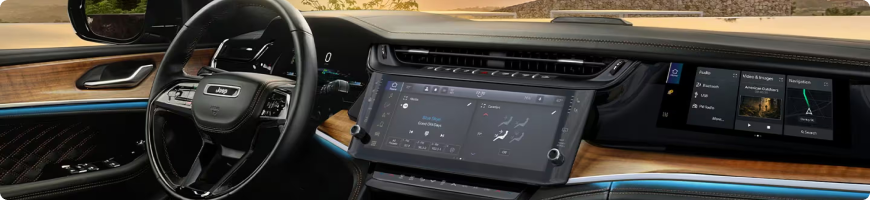
Uconnect 5 with navigation is standard on every Grand Cherokee, including the L, on a 12.3-inch touchscreen; our
Uconnect guide goes deeper on how it
works. A 10.25-inch full-digital instrument cluster is standard alongside it, as are wireless Apple CarPlay, wireless
Android Auto and a wireless charging pad.
Audio starts at 6 premium speakers with Active Noise Cancellation, steps up to 9 speakers with a subwoofer and a
506-watt amplifier, and tops out with available McIntosh High-Performance Audio: 19 speakers, a 10-inch subwoofer and a
17-channel 950-watt amplifier. Three further options are available: a 10.25-inch front-passenger touchscreen, so the
passenger is not reaching across the driver; a 10-inch head-up display; and rear-seat entertainment with the Amazon Fire
TV package.
The 2026 Grand Cherokee L holds a 5-star overall rating from NHTSA. That is a summary score; the individual crash-test
results behind it are published at NHTSA.gov.
The driver-assistance equipment across the Grand Cherokee family covers:
8 air bags
Blind Spot Monitoring and a ParkView back-up camera
ParkSense front and rear park assist with stop
Adaptive cruise control and Traffic Sign Recognition
Drowsy-Driver Detection and Hill Descent Control
Hands-Free Active Driving Assist, Night Vision and the Advanced ProTech Group IV package, all available rather than
standard
Which of these a given vehicle carries is listed on its window sticker, so tell us which ones matter and we will find
you one that has them.
Trims and Pricing
Seven trims share the Grand Cherokee ladder. The Laredo is the entry point, and in 4x4 it launched at $42,920 for the
2026 model year, excluding destination.
Trim
Where it sits
Best for
Laredo
The entry point
Buyers who want everything the L can do without paying for content on top. Up to 7 seats and Uconnect 5 are
standard here
Laredo X · Laredo Altitude
Laredo-family builds
Buyers who want a Laredo dressed differently. Drive both; they separate on equipment, not capability
Limited · Limited Reserve
The middle of the range
Buyers who want more interior content than the Laredo builds carry, without going to the top
Summit
The top of the range
Buyers who want the most equipped Grand Cherokee L Jeep builds
85th Anniversary Edition
A model-year special
Buyers who want a build specific to 2026 rather than a rung on the ladder
Capability does not change as you climb. No trim raises or lowers the 6,200-lb ceiling, and every trim carries the same
two engines and the same coverage, so what separates them is content. What a specific vehicle is rated to tow still
depends on how that vehicle was built, which is a question about the unit rather than the trim.
The McIntosh audio, the front-passenger screen and the Fire TV package are options rather than trims, so they can turn
up on more than one rung, and a vehicle’s window sticker is where its content is actually listed. A trim’s price is only
real once it is attached to a build, so our
Grand Cherokee L inventory
is where you see what each build actually sells for. Our Jeep specials change monthly, so see our
new vehicle specials for the deals
running now.
Which Trim Should You Choose?
There are three choices here, and the drivetrain is the one to settle first, because it is the hardest to change your
mind about later. If you drive Central Indiana winters, park outside, or spend time on gravel, the 4x4 build earns its
keep, and it costs 1 MPG combined on the turbo and nothing at all on the V6. If you commute on cleared pavement,
rear-wheel drive posts the better city figure on both engines. Then pick the engine, knowing both tow the same 6,200
lbs. Trim comes last, and it is the easiest to settle in person.
The full-time seven-seater: the third row is up more often than not. Take the turbo for the torque, and
look hard at the audio and rear-entertainment options, because this one will spend its life full of people.
The five-plus-luggage family: the third row goes up a handful of times a year and the rest of the time
you want the 46.9 cubic feet behind the second row. Either engine works.
The tow-and-haul household: a camper, a boat or a landscape trailer. Take the turbo for the low-rpm
torque, and confirm the rating on the exact vehicle.
If a trade-in is part of the arithmetic, settle that side first.
The basic term is the broad one and it runs out first. Powertrain coverage carries two more years and 24,000 more miles
past it, and roadside assistance runs on that same five-year term, which is the one that matters at 10 p.m. on I-69 with
a car full of family. Corrosion perforation covers rust-through and is the only term with no mileage limit, which counts
on a vehicle that lives outside through an Indiana road-salt season.
Buying One in Central Indiana
Three-row shopping comes down to two questions: does the third row work for the people who will sit in it, and does
the price hold from the listing to the paperwork. We answer the second with Up Front Guaranteed Pricing, which puts
the figure on the window and leaves it there.
The first only settles in person, and four things settle it. Bring your tallest regular passenger and put them in the
back row, because 30.3 inches reads one way on paper and another with a teenager in it. Set the middle row where your
family would keep it, then climb in behind it. Bring your car seats and install them in the row you would really use.
And load the stroller behind a raised third row, the real test of 17.2 cubic feet.
Every new Grand Cherokee L we sell comes with a complimentary first oil change, original owners get free car washes for
life, and our service department is open Saturdays. We are a straightforward drive from Noblesville, Fishers,
Indianapolis and Muncie; our
hours and directions
has the route. If you would rather settle the money before the metal, our
financing team works
across the full range of credit situations, including buyers new to the country or turned down somewhere else. If a used
one would suit you better, every factory
Certified Pre-Owned vehicle clears
a 125-point inspection and carries a CARFAX report, with two tiers of powertrain coverage set by model year and mileage.
Frequently Asked Questions
Up to 7. Seven is a ceiling rather than the only count, because the L is built in both 6-passenger and
7-passenger configurations, so check the seat count on the
Grand Cherokee L vehicles we have.
The L is 11.4 inches longer and adds a third row: up to 7 seats instead of 5, and 46.9 cubic feet behind the
second row against 37.7. Mechanically they are the same vehicle, sharing both engines, the same towing ceiling
and the same coverage. If a third row would only ride empty, the
two-row Grand Cherokee
is easier to park.
For short trips, yes. At 30.3 inches for the legs it is a real seat for kids and smaller teenagers and workable
for an adult across town, but not one two adults will enjoy on a long drive.
Sometimes, and it depends entirely on the seats. The second row, where we would put car seats, measures 56.3
inches across the hips, and car seats vary enough in width that no general answer is worth much. Bring yours and
install them on our lot, which is the only test that settles it.
Up to 6,200 lbs on a vehicle set up for it, which reaches a small travel trailer, a pop-up camper or a 17-foot
to 19-foot aluminum fishing boat. Confirm the figure on the exact vehicle and weigh your trailer loaded rather
than dry.
The 2.0L Hurricane 4 Turbo makes 324 hp and 332 lb-ft; the 3.6L V6 makes 293 hp and 257 lb-ft. The turbo is
stronger, rates better on fuel in every drive configuration, and delivers its torque 1,000 rpm earlier. The V6
suits you if you prefer how a naturally aspirated six drives. Both tow 6,200 lbs.
The base Laredo in 4x4 launched at $42,920, excluding destination. The seven trims are Laredo, Laredo X, Laredo
Altitude, Limited, Limited Reserve, Summit and the 85th Anniversary Edition. What an individual vehicle costs
turns on its equipment and on the incentives running, so check the
new vehicle specials.
It holds a 5-star overall rating from NHTSA. The individual crash-test results behind that score are published
at NHTSA.gov.
No. For 2026 the L comes with the two gas engines above.